Find resources to practice the piano between lessons can be a challenge for beginner piano students. To help we have pulled together the top 5 practise scales that a beginner should concentrate on mastering:
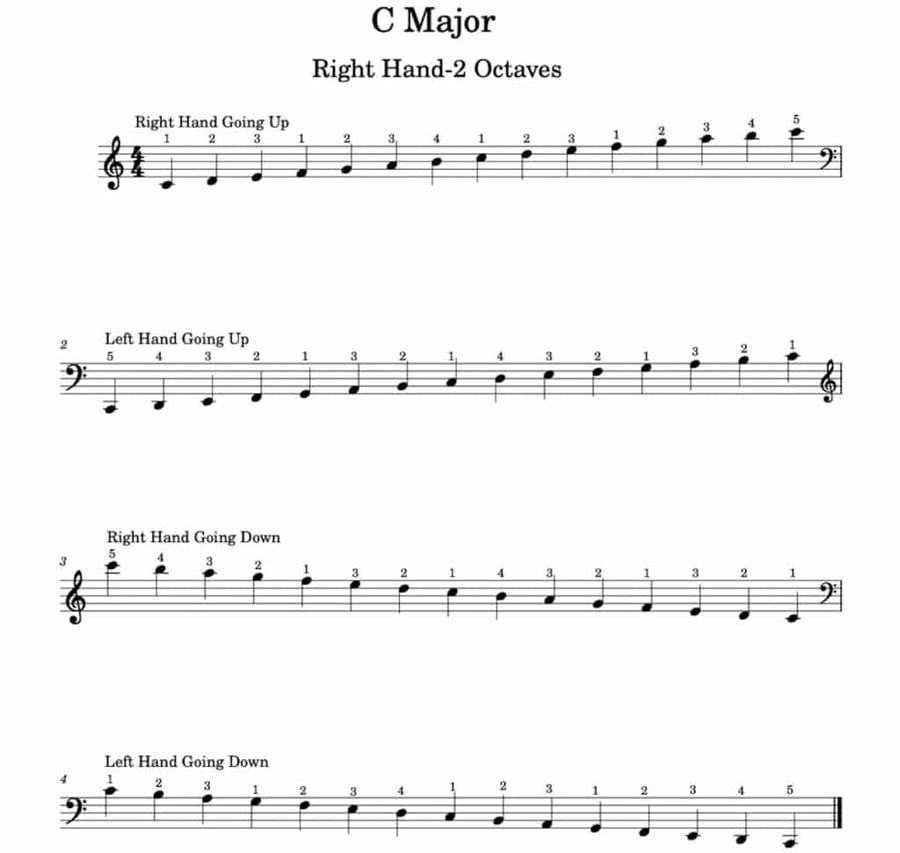
Scale 1: C Major
C Major is one of the easiest scales and usually the first one you learn when you begin learning how to play piano. The notes are all what we call “natural notes” which mean they are not flattened or sharpened.
The notes are as follows;
C D E F G A B C (the last C is what we call an Octave note which means it is 8 notes from Middle C, same note but a higher pitch)
There is also a set finger pattern to follow for each hand on the way up and on the way back down;
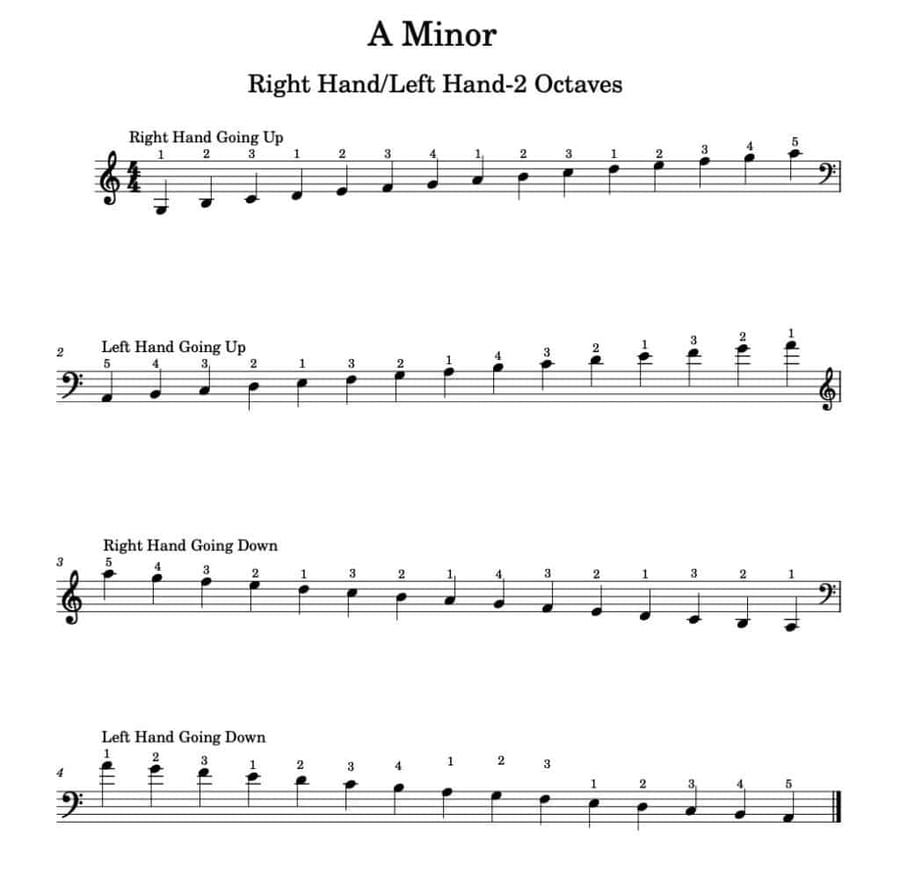
Scale 2: A Minor
A Minor is the relative minor scale of C Major. You find the scale by going to the 6th degree of the major scale which is the 6th note (A) from C. You then begin on A and as C Major has no sharps or flats, the A natural minor scale has none either. You can find the relative major scale by going to the third degree of Am which is C and use the same process. Try it with a few different scales, and then check the results-see if you got them. Finger patterns are the exact same too over one octave.
Scale 3: C Major Pentatonic
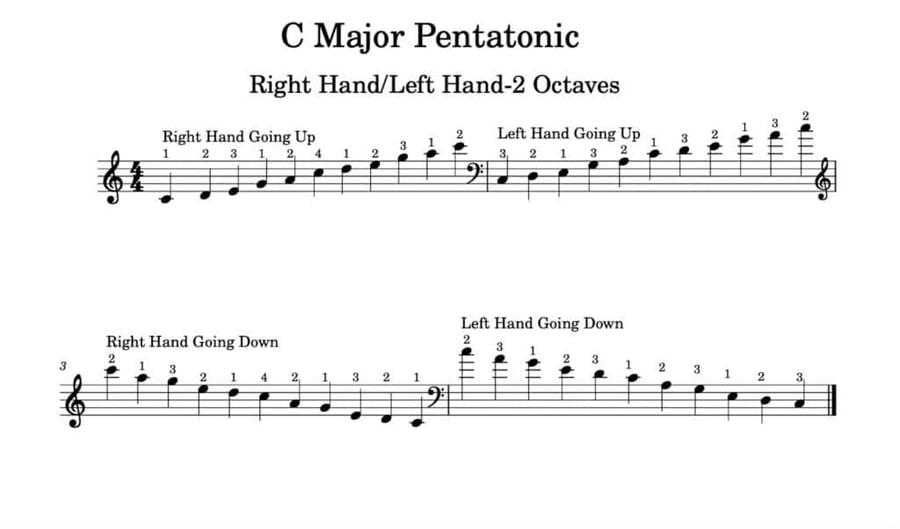
A pentatonic scale is a 5 note scale-taking only the 1st, 2nd, 3rd, 5th, 6th notes with the octave note at the top and leaving out the 4th and 7th notes. Guitarists use a lot of minor blues pentatonic scales for practise and also to write songs with.
The notes in a C Major Pentatonic Scale are as follows;
C D E G A C
There’s also another finger pattern for these types of scales;
Scale 4: A Blues Scale
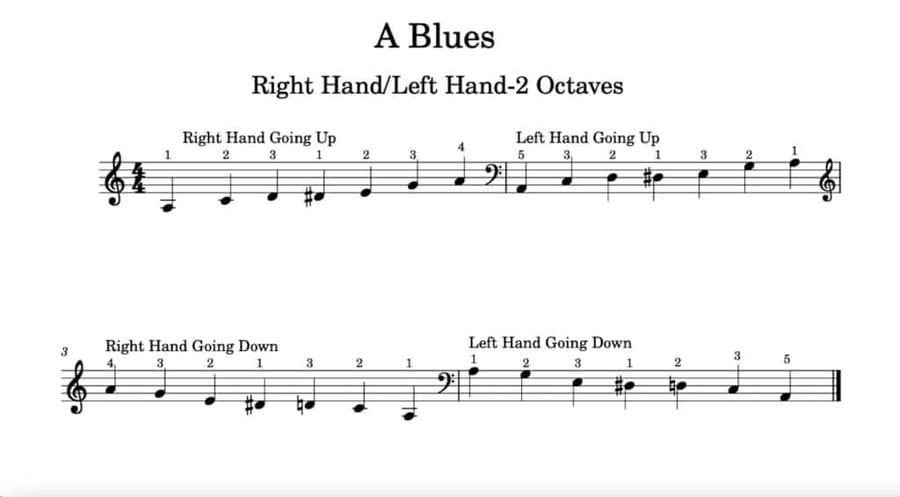
If you’re interested in learning Blues music, starting out with Blues scales is the perfect way to start and also to learn how to improvise. Just like a pentatonic scale, it uses less notes. Like so;
A C D Dsharp E G A
Finger pattern wise, it looks a little like this;
If you want to try improvising using this scale, you can find really good backing tracks on YouTube like this one:
Use the notes of the scale only and stick to the beat, but remember as long as you use the notes in the scale, nothing is right and nothing is wrong. It’s all about feel and what comes to you in that moment. You can keep it simple or you can try and add like inflections or ornamental notes etc.
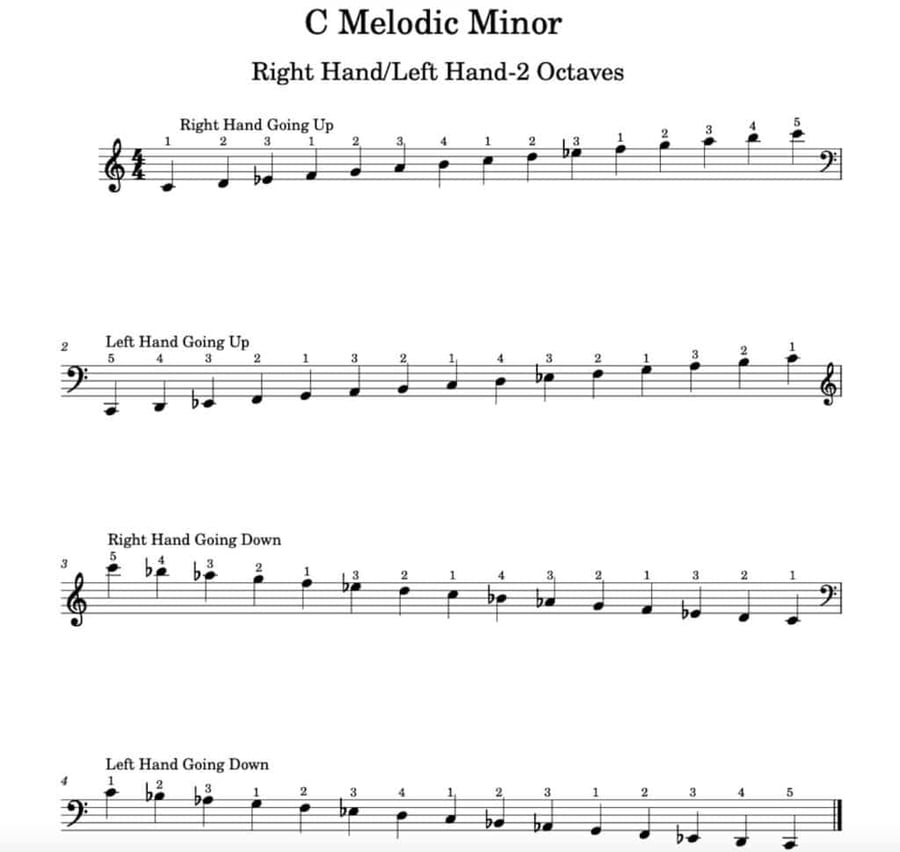
Scale 5: C Melodic Minor
There are different types of minor scales. You can get natural minor scales, like the one above, or you can get melodic or harmonic minor scales. C Melodic Minor is essentially the C Major scale but with a few differences. On the way up, the only note different is E which is flattened and on the way back down, B and A are both flattened too. Same finger pattern as a C Major scale too.
About the Author
Katie Wills is a professional piano teacher based in Glasgow, Scotland. She has many years of teaching experience, helping students of all learning abilities to develop their musicality, confidence and overall playing ability. She is passionate about helping students of all levels progress and helps to create resources for music students.