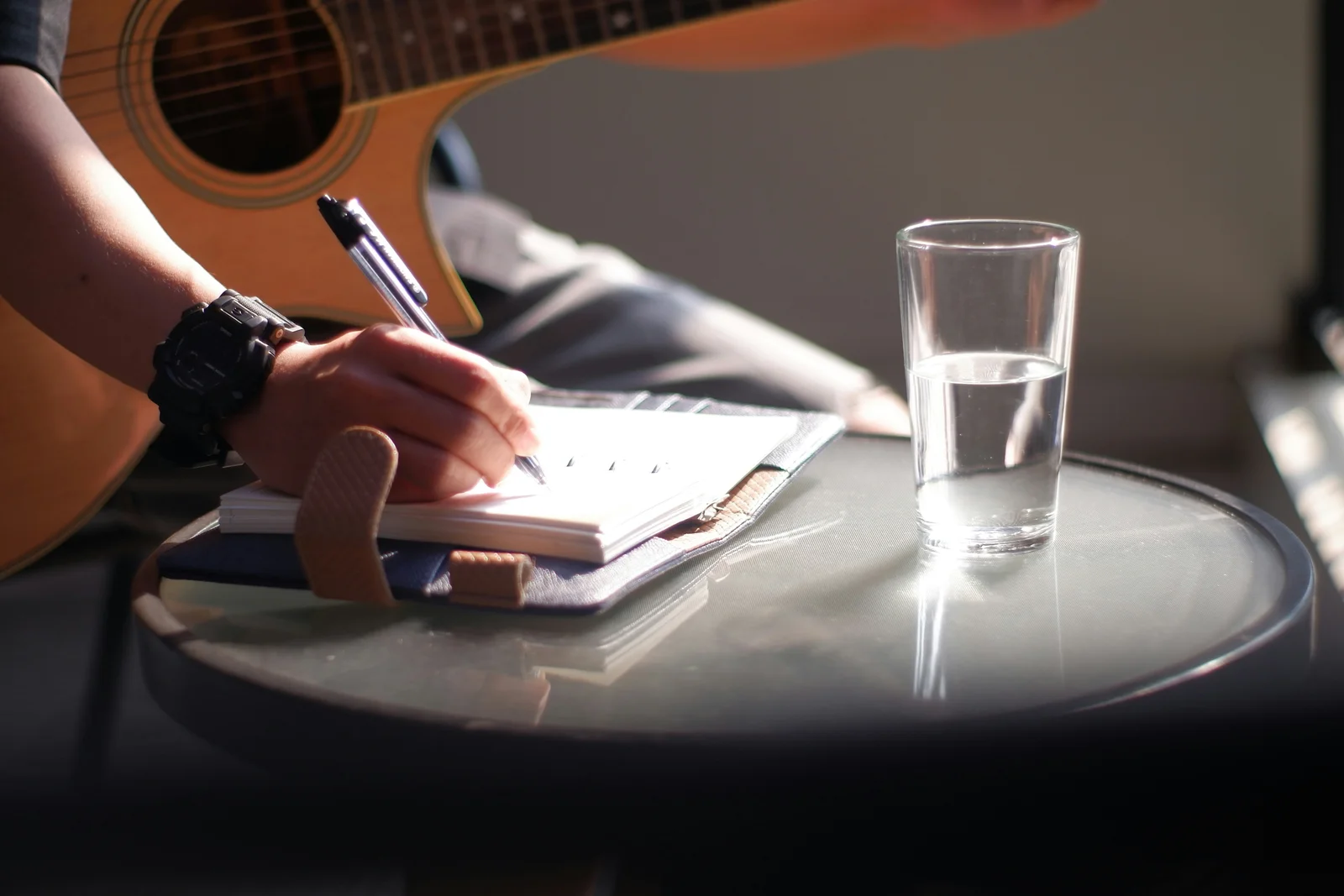
A music practice diary is a short record of what you intend to practise, what you actually try and what to do next. For beginner and returning music students, it gives you a place to turn lesson instructions into a plan and keep questions for your teacher. If you forget what you worked on between lessons, this record lets you pick up the next task without reconstructing the previous session. Start with five things: a task, a small goal, an approach, an observation and a next step. Below you can copy a weekly template and follow a worked example, using a notebook or a notes app.
If your lesson notes say “work on the new piece”, your diary can turn that instruction into something more specific: “Practise the change between bars 4 and 5 without stopping.” The template below is free to copy for your own practice. The worked examples are hypothetical, so adapt the tasks with your teacher rather than treating them as a prescribed programme.
What should you write in a music practice diary?
Write enough to remember your decision, without making the diary another large assignment. A piece title and a tick show that you played something; a passage number and a short observation show what you worked on. If you do not read notation, describe a recognisable moment, such as “the change into the chorus”, or use a timestamp from a recording you are allowed to use.
Practice notebooks can also connect lessons and home practice. ABRSM describes its Practice Notebook as a place for teachers to set goals and record progress, with a role for parents supporting practice. You do not need to buy a particular notebook or follow an exam syllabus to use that principle.
Time is an optional detail, not the whole entry. “Ten minutes on the opening phrase; still unsure about the rhythm” tells your teacher more than “ten minutes”. Record what happened honestly, including sessions that did not go as planned.
When it is useful, note the bar numbers, the key of an exercise and the metronome marking you used. For example, “bars 1–4 at 60 beats per minute, counting crotchets” is more precise than “played slowly”. That number is an example, not a target: use a tempo agreed with your teacher and note which note value gets the beat. Compare the same task under similar conditions rather than treating a faster number as the only sign of progress.
Copy this weekly music practice diary template
Copy these prompts into a document or notebook. Repeat the session entry whenever you practise and keep the weekly review beside it. Leave out any field that does not help you. This is an original MusicTeacher.com template for personal learning, not an assessment form.
Set up the week
- Week beginning: __________
- Music or skills I am learning: __________
- My teacher’s priorities, or my current learning goal: __________
- Small task to begin with: __________
- Possible practice opportunities this week: __________
- Something I want to enjoy playing or singing: __________
Record a practice session
- Date: __________
- Task: which piece, passage or skill? __________
- Goal: what am I trying to change? __________
- Approach: what will I try? __________
- Observation: what happened when I tried it? __________
- Next step: what will I repeat, change or ask? __________
- Optional: time spent, tempo or a recording reference: __________
Review before the next lesson
- One change I noticed: __________
- One thing that is still difficult or unclear: __________
- The passage I would like to demonstrate: __________
- My question for the teacher: __________
- The next priority we agree together: __________
A worked example: three sessions, one useful question
Imagine a beginner pianist learning a short piece. Their teacher has asked them to keep the pulse steady when moving into the second line. This example shows how the diary changes as the learner discovers the difficulty. It is not a real student’s record or a recommended timetable.
Session 1: locate the difficulty
- Task: the join between bars 4 and 5.
- Goal: keep counting through the join without a pause.
- Approach: play the right-hand part slowly, starting one bar before the join.
- Observation: I kept counting with the right hand alone, but stopped when I added the left hand.
- Next step: look at where the left hand moves before trying both hands again.
Session 2: record what remains uncertain
- Task: the left-hand move into bar 5.
- Goal: know where the hand needs to go.
- Approach: find the two positions, then try the move on its own.
- Observation: I can find both positions, but I am unsure which finger my teacher intended.
- Next step: mark the bar and ask about the fingering. Keep the uncertain movement out of repeated full run-throughs for now.
Session 3: prepare for the lesson
- Task: compare the opening phrase with the difficult join.
- Goal: show my teacher where the pulse changes.
- Approach: play each short section at a comfortable speed.
- Observation: the opening feels more settled; the join still needs help.
- Question for the lesson: “Could we check the left-hand fingering in bar 5 and agree how I should practise the join?”
The week does not need a perfect ending to produce a useful record. This learner has identified a specific uncertainty and can demonstrate it. After the lesson, they can replace the unanswered question with the teacher’s agreed approach.
Adapt the diary to your instrument or voice
Keep the same prompts and change the musical detail. The goal should describe something you can listen for or show your teacher, rather than simply “get better”. Choose a manageable task appropriate to your current level.
- Guitar: “Keep the pulse while changing between these two chords.” Note which change interrupts the rhythm and ask your teacher to check the movement.
- Singing: “Enter at the agreed point after the accompaniment.” Note the cue you listened for and whether it helped. Ask your teacher about any uncertainty instead of repeatedly guessing.
- Violin or another melody instrument: “Make the rhythm of this short phrase match my lesson notes.” Write down the exact note or bar where you lose your place.
- Drums: “Keep this agreed pattern going through the transition.” Note which part becomes uncertain, then bring that transition to the lesson.
These are sample diary entries, not instrument-specific technique instructions. Let your teacher choose suitable exercises and help you decide when to move on. If your goal is playing for enjoyment, include music you like; a diary does not have to revolve around exams or performances.
Use the diary without turning it into a chore
Choose paper or a digital practice journal
Paper can stay with your music and is easy to bring to a lesson. A digital note can be duplicated for each session and searched by piece title. Choose the option you will actually open. You do not need a paid app, an account or a new notebook to try this template.
If you use audio or video, a short reference such as “Tuesday, opening phrase” may be enough in the diary. Keep personal practice recordings private unless you choose to share them, and agree with your teacher before recording a lesson or anyone else. A recording should help answer a question, not become another task you feel obliged to complete.
Keep the plan realistic
Choose opportunities that fit your week and agree an appropriate amount of practice with your teacher. There is no single session length in this template. If a planned session does not happen, move the next useful task forward. Do not invent an entry or double the next session just to fill the page.
You can also add a short note about concentration or motivation: “distracted by notifications” or “enjoyed playing the melody at the end”. At your weekly review, look for repeated observations and choose one practical adjustment, such as putting the phone away or starting with a smaller task. These are personal observations, not grades or an objective measure of your ability.
If the same difficulty appears repeatedly, change the question rather than adding more ticks: “Am I clear about the rhythm?”, “Do I understand the movement?” or “Is this section too large to work on at once?” Write down the uncertainty and ask your teacher to help you choose the next step.
Let younger learners keep a simple version
A younger learner might use three prompts: “What did I try?”, “What did I notice?” and “What shall I ask?” A parent or carer can write down the child’s words. Check with the teacher how much support is useful, and avoid turning the diary into a daily judgement of whether the child worked hard enough.
Bring the diary into your next music lesson
Before the lesson, choose one entry to discuss and have the relevant music ready. Show what you tried, explain what remains unclear and ask for a specific next task. At the end, check that you can explain the task back in your own words.
If you are learning independently, use the same review to decide where feedback would help. You can explore music lessons by instrument on MusicTeacher.com and contact a teacher about your goals. Share a short example of what you are working on rather than feeling you need a polished performance before asking for help.
For parents choosing tuition for a child, our guide to finding a music teacher includes questions about practice expectations and parent involvement.
Other music practice journals to explore
If you prefer a ready-made journal, compare the space for lesson notes, your own reflections and questions for your teacher. Our free workbook is one option; the following publishers describe different approaches. Check their current formats, contents and availability before choosing.
Apollo Coaching practice journal
Apollo describes its journal as supporting teacher–student collaboration, with space for personal reflection and practical hints for tackling practice difficulties. That may be worth exploring if you want reflection alongside your practice record. These are the publisher’s stated aims, rather than independently verified benefits.
The ABRSM Practice Notebook
ABRSM describes its notebook as a place for teachers to record progress and set goals, with guidance that parents can use when supporting practice. Compare its lesson-note format with the kind of record you and your teacher want to keep.
Source and template notes
ABRSM’s notebook description was checked on 26 November 2026. The Apollo summary reflects the publisher’s description supplied to us; its current product details have not been independently checked. Our downloadable workbook, prompts and hypothetical examples are original MusicTeacher.com editorial guidance, not resources produced or endorsed by either publisher.